Loot v0: drops, rights, and a group roll window
Philosophy
Loot is one of the biggest reasons players keep logging in. Chase items, vertical progression, and the slow climb toward a build that is clearly yours are core to what makes an MMO worth the time you put into it. Loot v0 is the first real step toward that feeling.
What we are building toward:
- Chase items that matter. The top of the curve is rare by design so when a great piece drops, it is a moment.
- Vertical progression that you can actually see. Big gear jumps come from rare drops, not from slowly filling a bar. You want to remember where you were standing when the item hit the floor.
- Stat combinations as a chase. Two copies of the same item can vary greatly by stats, requirements, and even allowed classes.
- Ability scrolls with real weight. Scrolls carry class requirements, but those requirements can be subverted. That opens the door to creative, non-standard builds where your character can be truly unique.
- A real economy. Trade, class overlap, and sinks are part of the power curve. Not every upgrade should come from your own kills; some of the best moments come from bartering with other players.
What shipped
Kill rolls. When something dies, two things can happen. Gold can roll once, independently. Then a set of loot blocks are evaluated in order. Every block can fail its opening gate, which means nothing comes out of it on that kill. If a block does open, it picks a loot table (NPC’s can have many loot tables available to them), decides how many times to roll that table, and each of those rolls can still whiff. The layers are there to give developers four separate levers for tuning an item’s rarity.
Gold split. The leader decides whether gold is shared with the group or kept by the leader. When it is not shared, party members get a clear message as such.
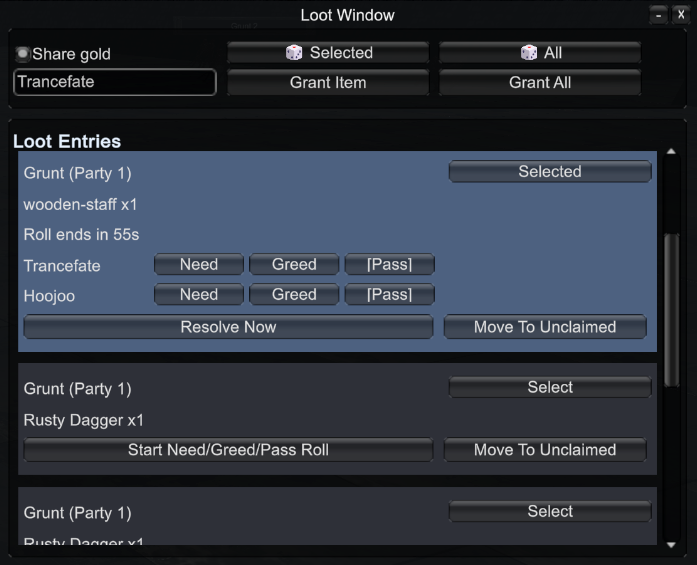
The loot window. When items drop, each gets its own entry in the loot window. The leader can start a roll on one entry, start rolls on everything pending, or directly give one or all items to a specific player. Players vote Need, Greed, or Pass. Need beats Greed. If nobody needs or greeds, the entry goes unclaimed. Unclaimed items can be reclaimed for a short time, and are then transmuted to gold for 1/3 of their value.
Protected vs Open. The first group to engage a target owns it. In this Protected state, only that group can damage the mob and only that group gets the loot. If the fight is not going well, or you want to invite help, the leader can open the fight up. Opening a fight is a one-way door; while an encounter is open any group can fight the pack, with the top damage party claiming experience and loot rights with top threat at time of death as a tie-breaker.
Here is the full probability that a specific item “X” ends up in the loot output on a given kill:

For the mathematically disinclined, it’s not not as scary as it looks. It is basically a series of questions asking “did any of these rolls succeed?” stacked on top of “and did the game actually pick the item X when they did?”. Every symbol maps to a real step the game is doing.
The short version: loot has to punch through four possible “Nope” gates before reaching you Loot block gate gate, table pick, roll count, item gate. Every one of those layers can shut the door.
Legend in plain language:
| Symbol | What it actually is |
|---|---|
| b, B | The loot blocks on this enemy. Think of each block as its own slot machine with its own rules. A kill runs through all of them in order. |
| γ_b | The opening gate on a block. This is the coin flip that decides whether the block even runs. Most blocks fail their gate on most kills. That is the point. |
| T_b, τ_{b,t} | The tables inside a block, and the odds of which table gets picked when the block opens. A block might have a “common stuff” table and a “rare stuff” table and heavily favor the common one. |
| m_b, M_b, κ_{b,k} | How many times the block rolls that table on this kill, and how likely each count is. Some blocks roll once. Some can roll several times if they feel like it. |
| μ_t | The whiff chance on a table. The table got picked, we are rolling it, and it still comes up dry. Welcome to loot. |
| E_t | The list of real candidates on the table for this kill. Currency and junk are filtered out already. |
| a_e | The entry check for a single row. This is the row saying “am I even allowed to be considered this time?” before we pick a winner. |
| w_e | Row weight. If several rows clear their entry check, weight decides the raffle. More weight means more tickets in the hat. |
| x_e | Is this row the item x you care about? 1 if yes, 0 if no. This is the trick that turns the whole formula into “odds of getting one specific drop” instead of “odds of getting anything at all.” |
| S ⊆ E_t | The subset of rows that passed their entry check on this roll. The sum over subsets is math saying “consider every possible combination of which rows qualified this time.” |
| Weighted fraction | Among the rows that qualified, your item’s share of the total weight. If the qualifying pile has no weight for any reason, we zero it out instead of dividing by zero and setting the universe on fire. |
| (…)^k | Same table, rolled k separate times on this kill. The k is the exponent because each roll is another chance for your item to show up. |